Class Mammalia
Cynomys ludovicianus (Prairie Dog)
Galeopterus variegates (Sunda flying lemur)
Ornithorhynchus anatinus (duck-billed platypus)
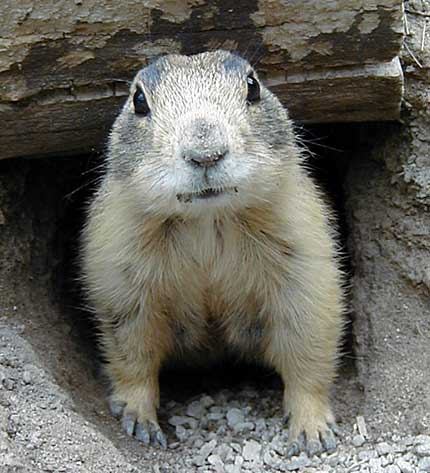
Prairie Dog
Cynomys ludovicianus
Phylum: Chordata
Family: Sciuridae
Genus: Cynomys
Species: Ludovicianus
•Detailed description of the organism
Prairie Dogs have stout bodies and a short tail. They grow to be 12 to 16 inches tall and weigh 1 to 3 pounds.
•Habitat
Prairie dogs live in underground burrows on North America's prairies and open grasslands.
•Diet
Prairie Dogs are herbivores. They emerge from their burrows during the day to forage and feed on grasses, roots, and seeds. They spend most of their time eating. Although Prairie Dogs are almost exclusively vegetarian, nursing females have been observed both cannibalizing and communally nursing each other's pups. The various native plants of the Great Plains make up the Prairie Dog's primary diet, comprising all kinds of grasses, roots, weeds, forbs and blossoms. They acquire all of their water from the food they eat. Sometimes insects are also eaten.
•Basic Growth and development cycles
Mating generally occurs in late January, with the young being born in March and April (a gestation period of 28 to 32 days). The White-tailed mates in March or April, with the young being born in May. These youngsters hibernate with their parents October through March in the north and in high mountain valleys.
Fun Facts:
A group of prairie dogs is called a Prairie Dog Town.
During the 20th century, 98% of all prairie dogs were exterminated because they were thought to be pests.
They kiss when they meet members of their own colony.
A group of prairie dogs is called a Prairie Dog Town.
During the 20th century, 98% of all prairie dogs were exterminated because they were thought to be pests.
They kiss when they meet members of their own colony.
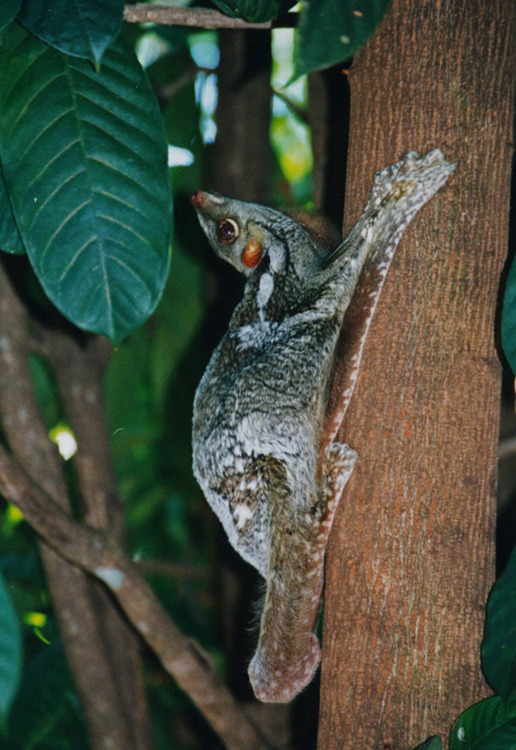
Sunda flying lemur
Galeopterus variegates
Phylum: Chordata
Family: Cynocephalidae
Genus: Galeopteru
Species:variegates
Phylum: Chordata
Family: Cynocephalidae
Genus: Galeopteru
Species:variegates
•Detailed description of the organism
About 34 to 38cm. 0.9 to 1.3kg.
•Habitat
The Sunda lemur is found inIndonesia Thailand Malaysia Singapore in the rain forested area.
The Sunda lemur is found in
•Diet
It eats the soft parts of plants, which include: plant leaves, shoots, flowers, and fruits.
It eats the soft parts of plants, which include: plant leaves, shoots, flowers, and fruits.
•Zoological features
The flying lemur has a kite shaped membrane surrounding its body that enables it
to glide called the patagium
•Basic Growth and development cycle
It goes through a 60-day gestation period, a single offspring is then carried on the mother's stomach held by a small piece of skin
It goes through a 60-day gestation period, a single offspring is then carried on the mother's stomach held by a small piece of skin
Fun Facts:
The Sunda flying Lemur is not a lemur and does not fly. It is the closest living relative of primates
It is active at night or nocturnal.
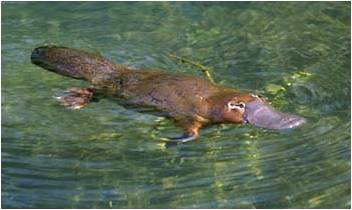
Duck-Billed Platypus
Ornithorhynchus anatinus
Phylum: Chordata
Family: Ornithorhynchidae
Genus: Ornithorhynchus
Species: Ornithorhynchus anatinus
Family: Ornithorhynchidae
Genus: Ornithorhynchus
Species: Ornithorhynchus anatinus
•Detailed description of the organism
Duck-billed platypuses are often described as looking like a duck and a beaver. They have a duck like bill and a flat broad tail like a beaver's. Their brown fur is dense to provide insulation. They have short arms and legs. Each foot has five webbed digits which have nails or claws. Males are larger than females. They live for up to 12 years.
•Habitat
Duck-billed platypuses live in Australia and Tasmania's wetter regions. They live in shallow rivers, lagoons, and streams with steep banks, roots, and lots of vegetation.
•Diet
They eat mostly aquatic invertebrates but also shrimp, small fish, and fish eggs.
•Zoological features
These animals have an elongated, stream-lined body. Males have venomous spurs on their hind legs.
•Basic Growth and development cycles
Duck-billed platypuses are monotremes, which means they are mammals that lay eggs. Females have mammary glands and the young have milk teeth.
Fun Facts: Duck-billed platypuses are generally solitary creatures.
They are protected by the Australian government.
Fun Facts: Duck-billed platypuses are generally solitary creatures.
They are protected by the Australian government.
Mammal Crossword Puzzle
Use the information you learned about the above mammals to complete the mammal crossword puzzle.

|
| ||||||||||||||||||||||||||||
